
Zeker. Voor deze pagina zou ik IFCL 1200 echt als authority page voor de standaard schrijven. Dus niet alleen uitleggen dat veilig laden en lossen belangrijk is, maar ook waarom juist het raakvlak tussen chauffeur, voertuig en vaste installatie risicovol is, welke beheersmaatregelen daarbij horen en hoe IFCL 1200 een internationaal kader biedt. Ik houd de tekst weer in langere, natuurlijk aangesloten alinea’s.
IFCL 1200: Safe Loading and Unloading of Chemical Tank Trucks
IFCL 1200 is an international safety standard for the loading and unloading of chemical tank trucks and dangerous goods tankers. Developed by the International Foundation for Chemical Logistics (IFCL), the standard provides a practical framework for controlling the risks that arise when liquid chemicals are transferred between a tank vehicle and a fixed installation. It addresses not only the transfer itself, but also the preparation of the operation, responsibilities of the parties involved, verification of the product and destination, connection of equipment, prevention of spills and overfilling, supervision, emergency arrangements and the safe completion of the operation.
Loading and unloading a chemical tanker may appear to be a routine logistics activity, particularly at sites where several vehicles are handled every day. In reality, it is one of the moments in the chemical supply chain when large quantities of product are deliberately moved outside their normal containment. Hoses or loading arms are connected, valves are opened and the tank becomes temporarily connected to the process or storage installation. An incorrect connection, unexpected pressure, damaged hose, overfilled tank or misunderstanding between the driver and site operator can consequently result in a significant release within a very short period of time.
The purpose of IFCL 1200 is to provide organisations with a structured international approach to managing these risks. The standard does not replace ADR, national occupational safety legislation, environmental requirements or site-specific rules. Instead, it provides a framework that connects regulatory compliance with the practical organisation of safe tanker loading and unloading.
Why tanker loading and unloading requires specific safety controls
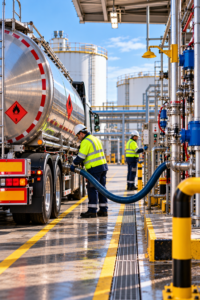 Chemical tank trucks are designed to transport substantial quantities of liquids or liquefied products safely, but the conditions change when the vehicle arrives at a loading or unloading installation. During transport, the product is normally contained within a closed tank. During transfer, that containment system becomes connected to another installation through hoses, couplings, valves, pumps or loading arms, creating additional potential points of failure.
The consequences of an error depend on the substance involved. A release of a flammable liquid can create a pool and a flammable vapour cloud, while a corrosive substance can cause severe injuries and damage equipment. Toxic products may expose employees even when the quantity released is relatively small, and environmentally hazardous liquids can enter drains, soil or surface water if the loading area does not provide adequate containment. Some substances may additionally react dangerously with water, air or residues of another chemical.
Pressure and flow introduce further risks. A hose failure during active transfer can release considerably more material than a leaking package in a warehouse. Incorrect valve operation can create pressure in sections of equipment that were not intended to be pressurised, while pumps can continue moving product after a problem has occurred unless the transfer is stopped quickly. Safe tanker operations therefore require technical protection and well-defined human actions to work together.
Clear responsibilities before the transfer begins
Loading and unloading operations normally involve at least two parties: the driver and the operator of the loading or receiving installation. In practice, other parties may also influence the operation, including the carrier, consignor, consignee, terminal operator and owner of the product. Safe transfer requires clarity about who is responsible for each part of the process.
Before operations begin, the site should establish who verifies the vehicle, confirms the product, selects the correct connection, operates the relevant valves and pumps, monitors the transfer and authorises departure. The procedure should also define who has authority to stop the operation if something appears unsafe. Ambiguity becomes particularly dangerous when each person assumes that the other has completed an important check.
Communication is therefore a safety control in its own right. The driver may be familiar with the vehicle but unfamiliar with the installation, while site personnel understand their own equipment but may not know the specific configuration of every tanker that arrives. Language differences can create an additional challenge at international logistics sites. Critical information should consequently be communicated in a way that both parties understand, supported by clear procedures and, where useful, standardised checklists.
Verify the product, tank and destination
One of the most serious tanker transfer errors is delivering the correct product to the wrong tank or connecting the wrong product to an installation. The consequences can extend far beyond product contamination. If incompatible substances are mixed, an incorrect delivery can cause heat generation, gas formation, polymerisation, pressure increase or other dangerous chemical reactions.
Product verification should therefore take place before the connection is made. The substance identified in transport and delivery information should correspond with the product expected by the site, while the correct receiving tank or loading source should be positively identified. Where several connections are located close together, relying on memory or the physical appearance of pipework is insufficient. The available capacity of the receiving tank also needs to be confirmed. A nominal tank capacity does not indicate how much product can safely be added at a particular moment. Existing inventory, maximum permitted filling level and any necessary vapour space must be considered before transfer begins. Where loading a vehicle, the permissible filling level and vehicle requirements must similarly be verified.
Positive identification is preferable to assumptions based on routine. The fact that a driver has delivered the same product to the same site many times does not eliminate the possibility of a mistake. Familiarity can itself create risk when routine causes checks to be shortened or skipped.
Positioning and securing the tank truck
The condition and position of the vehicle influence the safety of the entire operation. The tank truck should be located at the designated loading or unloading position so that connections can be made without excessive tension, sharp bends or unnecessary movement of hoses.
Vehicle movement during transfer can have serious consequences. If a truck drives away while still connected, hoses, loading arms and pipework can be damaged and a large release can occur. Measures should therefore be used to prevent unintended movement. Depending on the installation, these can include parking brakes, wheel chocks, barriers, interlocks, keys or other vehicle restraint systems.
Traffic around the tanker should also be controlled. A loading area in which forklifts, trucks or other vehicles routinely pass close to transfer equipment introduces an additional collision risk. The site layout should separate transfer operations from unnecessary vehicle movements where reasonably practicable and protect vulnerable equipment against impact.
Safe access for the driver and operator is equally important. Slippery surfaces, hoses across walkways and the need to climb onto a vehicle can introduce occupational risks even when the chemical transfer itself proceeds correctly. Loading and unloading safety therefore needs to consider the complete work area rather than only the connection point.
Hoses, loading arms and couplings
Transfer equipment forms the temporary connection between the tanker and the installation and must be suitable for the substance, pressure and operating conditions. Hoses can deteriorate internally or externally, couplings can become damaged and seals can lose their integrity. Visual inspection before use is therefore important, but it should form part of a wider inspection and maintenance programme rather than being the only control.
Chemical compatibility is essential. Hose materials, gaskets and seals must be suitable for the substance being transferred. A material that performs well with one chemical may deteriorate when exposed to another. Temperature and pressure can further influence suitability.
Connections should be correctly identified so that the likelihood of connecting a product to the wrong line is minimised. Different coupling systems, mechanical keying, labelling, colour coding or other identification methods may support this objective, but visual identification alone should not replace verification of the product and destination.
Before opening valves, the connection should be checked to ensure that it has been properly secured. The routing of flexible hoses should avoid unnecessary stress, vehicle traffic and conditions that could damage the hose during transfer. Where dry-break or other specialised couplings are used, employees should understand their correct operation and limitations.
Preventing overfilling
Overfilling can result in a substantial release and is therefore one of the central scenarios that should be addressed in a tanker transfer risk assessment. The available capacity needs to be known before the transfer begins, while the quantity being transferred should be monitored during the operation.
Technical overfill protection can provide an important additional layer of safety. High-level alarms, automatic shut-off systems and independent overfill protection may be appropriate depending on the installation and risk. Such systems should not create false confidence, however. They require testing and maintenance, and employees should understand what happens when an alarm or trip is activated.
Transfer rate also matters. A rapidly filled tank provides less time to respond if an incorrect level or other abnormal condition is identified. Procedures should therefore establish appropriate operating limits and clarify how the transfer will be stopped under both normal and emergency conditions.
When the tanker contains several compartments, additional attention may be required to ensure that the intended compartment is being filled or emptied and that quantities remain within applicable limits.
Static electricity and ignition control
The movement of certain liquids through hoses and pipework can generate static electricity. When flammable vapours are present, an electrostatic discharge may provide sufficient energy for ignition. Loading and unloading flammable liquids therefore requires consideration of bonding, earthing or grounding and the conductivity of transfer equipment where relevant to the substance and operation.
The loading area should also be assessed for other ignition sources. Electrical installations, vehicles, mobile equipment, hot surfaces, smoking and maintenance activities can all be relevant. Where an explosive atmosphere can occur, applicable hazardous-area requirements need to be taken into account.
The required controls depend on the properties of the substance and the transfer method. Not every chemical tanker operation presents the same electrostatic or explosion risk, which is why site-specific assessment remains necessary even when an international standard is used as the broader framework.
Supervision during loading and unloading
A tanker transfer should not become an unattended process simply because the product has started flowing normally. Conditions can change quickly when a hose fails, a connection begins leaking, a tank approaches its maximum level or another abnormal situation develops.
The operation should therefore be supervised in accordance with the risks and site procedures. The responsible person should be able to recognise abnormal conditions and stop the transfer promptly. Where automatic systems are used, the organisation should define what level of human supervision remains necessary and how alarms are managed.
Distractions can undermine this control. Administrative work, telephone use or simultaneous responsibility for unrelated operations can reduce the ability to identify developing problems. The expected role of the driver and site operator during the transfer should therefore be established before the operation begins.
Where the driver is permitted or expected to carry out particular site operations independently, the organisation needs to ensure that the driver has received adequate instructions and understands the installation. The fact that a person is qualified to drive a dangerous goods vehicle does not automatically mean that they are competent to operate every loading or unloading installation.
Spill containment and drainage
Even with effective preventive measures, loading areas should be designed on the assumption that a release can occur. The surface should allow spilled product to be controlled and should prevent dangerous substances from immediately entering soil, surface water or uncontrolled drainage systems.
Containment arrangements depend on the potential release scenario. A small drip from a disconnected hose requires a different response from a full-bore hose failure during active pumping. The design should therefore consider credible quantities and flow rates rather than only routine minor spills.
Drainage systems can become an important part of the emergency response. Shut-off valves, collection pits or other isolation arrangements may be needed to prevent a chemical release from leaving the site. Employees responsible for operating these systems should know where the controls are located and how they are used.
Spill-response equipment should be suitable for the chemicals handled at the installation. Generic absorbents may not be appropriate for every substance, and some releases should not be approached without specialist protective equipment. Procedures should clearly distinguish between incidents that trained site personnel can manage and situations requiring evacuation and emergency response.
Emergency shutdown and response
The ability to stop product flow quickly can significantly reduce the consequences of a transfer incident. Emergency shutdown arrangements should therefore be accessible to the people supervising the operation and designed so that activation results in a predictable safe response.
Depending on the installation, emergency shutdown may stop pumps, close valves or isolate sections of the transfer system. The sequence should be assessed carefully because rapidly closing valves in a flowing system can itself create pressure effects. Technical design and operational procedures therefore need to be considered together.
Drivers and site personnel should know how to raise the alarm, where emergency controls are located and what actions are expected following a spill, fire, hose failure or other abnormal event. Emergency arrangements should also consider exposure to chemicals, first aid, evacuation, fire response and protection of the environment.
Exercises can help determine whether these procedures work in practice. A written procedure may appear clear until an exercise reveals that an emergency stop is difficult to reach, employees are unsure who should contact emergency services or a drainage isolation valve cannot be operated safely during a release.
Completing the transfer safely
The end of the operation deserves the same attention as the beginning. Residual product can remain under pressure in hoses or pipework, and disconnecting equipment before it has been safely depressurised or drained can expose employees to chemicals.
The correct sequence for stopping pumps, closing valves, relieving pressure and disconnecting equipment should therefore be defined for the installation. Hoses or loading arms should be returned to their designated positions and caps or closures fitted where required. Any leakage should be addressed before the vehicle leaves the loading area.
A final check can confirm that all connections have been removed, vehicle equipment is secured and the tanker is ready for transport. Where dangerous goods regulations require placards, orange-coloured plates, documentation or other transport provisions, these should also be correct before departure.
Drive-away incidents demonstrate why this final verification matters. A vehicle should never be released simply because product transfer has stopped; the complete transition from stationary transfer operation back to road transport needs to be controlled.
Training and competence
Safe tanker loading and unloading depends heavily on the competence of the people involved. Drivers may have dangerous goods training required under transport regulations, while site operators receive training relating to their installation and company procedures. These areas of knowledge overlap but are not interchangeable.
Training should reflect the actual tasks performed. Personnel may need to understand product hazards, site rules, verification procedures, transfer equipment, valve sequences, overfill protection, static electricity controls, spill response and emergency shutdown arrangements. Where several products are handled, employees should understand the significance of contamination and chemical incompatibility. Practical instruction is particularly valuable because loading installations differ considerably. Knowing the general principle of safe transfer does not automatically mean that a person can safely operate an unfamiliar installation.
Competence should also be reviewed following changes to equipment, products or procedures. A modified connection system, new chemical or revised automation system may alter the way the operation needs to be performed even when the basic task remains described as tanker loading or unloading.
IFCL 1200 as an international safety framework
IFCL 1200 provides an international framework for the safe loading and unloading of chemical and dangerous goods tank trucks. Its value lies in considering the transfer as a complete operation rather than concentrating on a single component such as the hose, vehicle or driver. Preparation, communication, technical equipment, operating procedures, supervision and emergency arrangements all contribute to the eventual safety level.
The standard is particularly relevant in an international sector because chemical tankers routinely cross borders and drivers encounter many different loading and unloading installations. National legislation and company procedures may vary, while the underlying hazards of transferring flammable, corrosive, toxic or environmentally hazardous substances remain comparable.
IFCL 1200 does not replace ADR or other applicable regulations. ADR establishes important responsibilities and requirements associated with the carriage, loading and unloading of dangerous goods, while occupational safety, environmental, fire and industrial legislation may impose additional requirements at the installation. Companies remain responsible for identifying and complying with the legislation applicable to their activities and location.
An international standard can nevertheless provide a common reference for evaluating how an operation is organised. Multinational chemical producers and logistics companies can use common principles when assessing loading sites in different countries, while individual facilities can use the framework to identify gaps between legal compliance and established good practice.
From routine operation to controlled transfer
One of the greatest challenges in tanker safety is precisely that loading and unloading often becomes routine. An experienced driver may perform hundreds of transfers each year, while an operator at a busy chemical facility may connect several vehicles during a single shift. Repetition increases experience, but it can also reduce the attention given to checks that rarely reveal a problem.
A safe system should therefore be designed so that important controls do not depend solely on memory or individual vigilance. Positive product identification, clearly assigned responsibilities, engineered overfill protection, suitable connections, accessible emergency shutdown systems and structured pre-transfer checks provide layers of protection. If one layer fails, another may prevent the error from developing into a serious incident. Near misses and abnormal events should also be used as sources of information. An incorrect connection identified before a valve is opened, an overfill alarm that activates unexpectedly or repeated damage to transfer hoses may indicate weaknesses that deserve investigation even when no product has been released.
IFCL 1200 supports this broader approach in which tanker loading and unloading is managed as a safety-critical process rather than merely a logistics activity. Combining technical safeguards with competent personnel, clear responsibilities and effective procedures can significantly reduce the probability that a routine chemical transfer develops into a major incident.
Frequently Asked Questions about IFCL 1200 and Tanker Loading
What is IFCL 1200?
IFCL 1200 is an international safety standard for the loading and unloading of chemical and dangerous goods tank trucks. It provides a structured framework for controlling the technical, operational and human risks associated with transferring chemicals between tank vehicles and fixed installations.
Does IFCL 1200 replace ADR?
No. IFCL 1200 does not replace ADR or other applicable legislation. ADR requirements continue to apply where relevant to the carriage, loading and unloading of dangerous goods. IFCL 1200 provides an additional international safety framework for organising and assessing tanker transfer operations.
What are the main risks when unloading a chemical tanker?
Important risks include connecting the wrong product or tank, hose or coupling failure, overfilling, chemical exposure, spills, static electricity, ignition of flammable vapours, unexpected pressure, vehicle movement and errors in communication between the driver and site operator.
Who is responsible for safe tanker unloading?
Responsibilities depend on the applicable legislation and the organisation of the operation. Drivers, carriers, consignors, consignees and loading or unloading sites may each have specific responsibilities. At operational level, responsibilities should be clearly defined before transfer begins so that important checks are not assumed to have been completed by another person.
Should a tanker driver remain present during unloading?
The required supervision depends on the operation, applicable regulations and site procedures, but chemical transfer should be adequately supervised so that abnormal conditions can be recognised and the flow can be stopped promptly. The responsibilities of the driver and site operator should be agreed before the operation begins.
Why is overfill protection important?
A tanker or receiving tank can release a substantial quantity of chemical if it is overfilled. Verifying available capacity, monitoring the transfer and using appropriate high-level alarms or automatic overfill protection can provide several layers of protection against this scenario.
Why should hoses be inspected before use?
Transfer hoses are exposed to chemical attack, pressure, mechanical damage, ageing and repeated handling. Damage can result in a significant release during transfer. Pre-use inspection should therefore be combined with a planned inspection, testing and replacement programme appropriate to the hose and service conditions.
Is an ADR driver’s certificate enough to operate a loading installation?
Not necessarily. ADR driver training provides important dangerous goods knowledge, but individual loading and unloading installations can have specific equipment, procedures and risks. Drivers or operators performing site-specific activities need sufficient instruction and competence for those particular tasks.