
Dangerous goods segregation is the practice of separating substances that could create additional hazards if they came into contact with each other during storage. In a chemical warehouse, segregation is particularly important because leaking packages, fires, damaged containers or contaminated firefighting water can bring substances together that would never normally be mixed during routine operations. A safe storage arrangement therefore considers not only the individual hazards of each product, but also what could happen when different products become involved in the same incident.
Transport classifications such as ADR classes provide useful information about the primary hazards of dangerous goods, but they should not be used as the sole basis for determining warehouse segregation. Products within the same transport class can have very different chemical properties, while substances belonging to different classes may sometimes be stored in the same area when suitable controls are present. Safety Data Sheets, chemical compatibility information, quantities, packaging, storage conditions and applicable national regulations all need to be considered.
For organisations operating internationally, this can be challenging because requirements for dangerous goods storage differ between countries. IFCL 5050 – International Standard for the Storage of Packaged Dangerous Substances provides an international framework in which compatibility and segregation form part of the wider assessment of chemical warehouse safety.
Why is segregation necessary in a chemical warehouse?
Most dangerous goods remain safely contained during normal warehouse operations. Problems arise when that primary containment fails. A drum can be punctured by a forklift, an IBC valve can be damaged, a package can fall from a pallet or several containers can become involved in a fire. Once substances are released, the relationship between neighbouring products becomes important.
Two relatively manageable leaks can create a much more serious situation if the substances react when mixed. A reaction may generate heat, cause splashing or boiling, increase pressure or produce flammable or toxic gases. In a fire, incompatible products can also increase the severity of the incident or make firefighting considerably more difficult.
Segregation is intended to reduce the likelihood of such escalation. It does not necessarily mean that every type of dangerous substance needs its own building or storage room. The required degree of separation depends on the properties and quantities of the substances, the packaging, warehouse design and the measures available to prevent released substances from interacting.
This makes segregation fundamentally a risk-control measure rather than simply an administrative method of arranging products on warehouse shelves.
ADR classes are not a chemical compatibility system
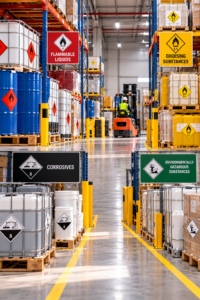 One of the most common mistakes when designing dangerous goods storage is to use transport classes as if they were a complete chemical compatibility system. ADR labels are highly visible on dangerous goods packages and provide an obvious way to divide stock, but their primary purpose is transport hazard communication.
A Class 3 label, for example, indicates a flammable liquid transport hazard. It does not provide all the information needed to determine which other chemicals the substance can safely be stored beside. Similarly, products assigned to Class 8 are corrosive substances, but this class can include both acidic and alkaline products. Placing all Class 8 products together without considering their chemical properties can therefore create exactly the type of incompatibility that segregation is intended to prevent.
The same principle applies across other classes. A transport classification describes specific hazards according to dangerous goods regulations, but warehouse compatibility requires a broader understanding of the substance. The presence of subsidiary hazards can provide additional information, yet even the complete transport classification should not automatically be treated as a storage compatibility decision.
ADR classification can therefore be an important starting point, but it should be combined with chemical and storage-specific information.
Use the Safety Data Sheet to understand incompatibilities
The Safety Data Sheet is an important source of information when assessing chemical compatibility. Several sections can contribute to a segregation decision rather than relying on a single statement.
Section 2 provides information about the hazards and classification of the substance or mixture. Section 5 addresses firefighting measures, while Section 6 contains information about accidental releases. Section 7 covers handling and storage and may specify incompatible materials or particular storage conditions. Section 10 is especially important because it addresses stability and reactivity, including conditions to avoid, incompatible materials and hazardous decomposition products.
Transport information in Section 14 can be useful for identifying the dangerous goods classification, but it should be read alongside these other sections. A warehouse operator who considers only Section 14 risks reducing a chemical compatibility assessment to a transport classification exercise.
The quality and level of detail in Safety Data Sheets can vary, so additional information may sometimes be required. Specialist chemical compatibility data, supplier information or technical expertise may be necessary when the consequences of mixing substances are unclear.
Where compatibility cannot be established with sufficient confidence, a more conservative storage arrangement may be appropriate until the risks have been properly assessed.
Acids and alkalis require particular attention
The distinction between acids and alkalis illustrates why transport class alone is insufficient. Both can be classified as corrosive substances, often within Class 8 for transport purposes, but strong acids and strong bases can react vigorously when mixed. Such reactions can generate considerable heat and cause liquids to boil or splash. Depending on the products involved, additional gases or reaction products may also be generated. Storage arrangements should therefore consider whether a leak from one storage position could reach an incompatible product.
This does not automatically mean that every acid and every alkaline product must always be located in entirely separate buildings. The appropriate measure depends on quantities, concentrations, packaging, containment and applicable requirements. Separate bunds, storage cabinets, compartments or physically separated areas may provide suitable controls in different circumstances. The important point is that the decision is based on the potential reaction rather than the fact that both products happen to carry a similar transport label.
Keep oxidising substances away from combustible materials
Oxidising substances present another important segregation issue. They may not necessarily burn themselves, but they can support combustion or considerably increase the intensity of a fire involving other materials. For this reason, oxidisers require careful consideration in relation to flammable liquids, combustible chemicals and other combustible materials. The warehouse environment itself must also be considered. Pallets, cardboard packaging and other materials can contribute to the fire load even if the chemical product being stored is not itself classified as flammable.
Organic peroxides and other reactive substances can require still more specific controls because temperature, contamination or contact with incompatible materials can result in decomposition. In such cases, segregation may form only one part of the required storage concept, alongside temperature control and other technical measures. A compatibility assessment should therefore consider how substances could influence one another during an incident rather than simply whether each product can independently be stored in the building.
Water-reactive substances create different scenarios
Water is one of the most commonly used firefighting agents, but some dangerous substances react with water. These substances require particular attention because both a routine spill and an emergency response can create additional hazards.
Depending on the substance, contact with water may generate heat, release flammable gases or produce toxic or corrosive reaction products. Storage near water-based products or in an area where leaking liquids can collect may therefore require additional controls.
Fire protection also needs to be considered carefully. A general warehouse firefighting strategy may not automatically be appropriate for every substance present. Emergency plans should identify materials that can react dangerously with water so that responders have access to this information before selecting an intervention strategy.
This illustrates why segregation cannot be considered separately from emergency planning. The same chemical properties that determine where a product should be stored can also determine how an incident involving that product should be managed.
Consider toxic gases that can be generated accidentally
Some of the most serious compatibility scenarios involve substances that can generate toxic gases when they come into contact with other chemicals. The individual products may be routinely handled without difficulty, while accidental mixing can create an immediate hazard extending beyond the point of release.
These scenarios deserve particular attention because the consequences may not remain inside the storage area. Gas formation can expose employees, emergency responders and potentially people outside the warehouse.
Where such combinations are present, prevention of contact becomes especially important. Separate containment can be valuable because physical distance alone may not prevent liquids from mixing if a major spill or firefighting operation causes them to travel across the warehouse floor.
The assessment should therefore consider not only neighbouring pallet positions but also drainage routes, floor gradients, bunds and the possible movement of liquids during credible incidents.
Segregation is more than distance between pallets
The term segregation can suggest that dangerous goods simply need to be positioned a certain distance apart. In practice, several different methods can be used to prevent incompatible products from interacting.
Physical separation may be sufficient in some situations, while others require separate containment systems, dedicated cabinets, storage sections or fire-resistant compartments. Different warehouse zones can also be created for particular hazard groups. The appropriate solution depends on the substances, quantities, incident scenarios and requirements applicable to the facility.
Containment deserves particular attention. Two incompatible substances can be stored several metres apart and still mix if both leak into the same drainage channel or bund. Conversely, well-designed separate containment may provide a significant degree of protection even where products are located within the same broader storage area.
Fire compartmentation serves a somewhat different purpose. It can reduce the likelihood that a fire spreads between storage areas and can provide additional time for intervention. Whether compartmentation is necessary should be determined from the overall fire and storage concept rather than assuming that it automatically resolves every compatibility issue.
Effective segregation therefore usually results from a combination of warehouse layout, containment, fire protection and operational control.
Temporary storage must not become a blind spot
A warehouse may have a carefully designed segregation plan for its permanent storage locations while paying much less attention to goods that have not yet reached those locations. Receiving areas, staging zones, order-picking locations and dispatch areas can consequently become weak points.
Incoming pallets may remain together for several hours before being put away. Products picked for different customers can be assembled in the same dispatch area, while returned goods may be placed wherever temporary space is available. During busy periods, these temporary arrangements can last considerably longer than originally intended.
Segregation principles should therefore extend throughout the warehouse process. If two substances require separation in the storage racks because accidental mixing would be dangerous, placing them immediately beside each other in the receiving area deserves the same consideration.
Warehouse management systems can help by assigning products to approved locations and preventing incompatible combinations. These systems are most effective when the compatibility rules behind them are technically sound and employees understand why the restrictions exist.
Damaged and leaking packages should be isolated
Damaged goods present a different risk from intact packaged substances because primary containment may already have been compromised. A leaking drum or damaged IBC should therefore not simply be moved to another ordinary pallet position.
Warehouses handling dangerous goods should have procedures for isolating suspect packages and assessing the appropriate response. Depending on the product and condition, this may involve overpacking, transferring the package to a dedicated incident area or arranging specialist disposal.
The location used for damaged goods also requires a compatibility assessment. A single quarantine area for every type of chemical can itself create an unsafe situation if incompatible leaking products are placed together. Where a facility handles a broad range of substances, separate containment or other arrangements may be necessary within the damaged-goods area.
The same principle applies to unidentified substances. Until the contents and hazards are established, they should not automatically be assigned to a normal storage group.
Firefighting water can defeat normal segregation
Chemical compatibility is often considered in relation to relatively small spills, but major incidents can change the way substances move through a warehouse. During firefighting, substantial quantities of water may enter storage areas and carry released chemicals beyond their normal containment.
If several incompatible substances are involved, contaminated water can create opportunities for mixing that would not exist during routine operations. Drainage and firefighting-water containment therefore form part of the wider segregation strategy.
A warehouse assessment should consider where contaminated water would flow, whether separate storage sections share drainage systems and whether released substances could reach neighbouring areas. The capacity and chemical resistance of containment systems may also need consideration.
This broader approach is especially important in large warehouses where many different product groups are stored within one building.
Keep the segregation plan connected to actual stock
A segregation plan only works if it reflects the products actually present in the warehouse. Chemical logistics operations change continuously as new products are introduced, customers change and stock quantities fluctuate.
Before accepting a new chemical product, the organisation should determine its hazards and compatibility requirements and identify an appropriate storage location. Allowing products to enter the warehouse before this assessment has been completed can result in temporary arrangements becoming permanent without adequate review.
Inventory and warehouse management systems can support this process by recording storage restrictions and approved locations. Periodic physical inspections remain important because the actual warehouse arrangement may differ from administrative records.
Changes in quantities can also affect the appropriate controls. An arrangement that is reasonable for a few small packages may require reassessment when the quantity increases substantially. Segregation should therefore form part of change management rather than being established once when the warehouse is first designed.
Training employees in segregation principles
Employees do not need to become chemists to work safely in a dangerous goods warehouse, but they do need to understand the rules relevant to their tasks. A warehouse employee who is instructed only to place a product in “Zone B” may follow the procedure without recognising why moving it temporarily to another area could create a problem.
Training should therefore include the purpose of segregation, recognition of the relevant hazards and the procedures for products that cannot be placed in their assigned locations. Employees should know what to do when they find damaged packaging, unidentified goods or stock in an incorrect storage area.
Supervisors and employees responsible for determining storage arrangements require a deeper level of knowledge. They need to understand how information from Safety Data Sheets, chemical properties and applicable requirements is translated into practical warehouse rules.
Within the IFCL framework, competence associated with packaged dangerous substances is addressed through IFCL 5051, complementing the broader storage safety principles covered by IFCL 5050.
Segregation within IFCL 5050
IFCL 5050 – International Standard for the Storage of Packaged Dangerous Substances addresses compatibility and segregation as part of an integrated approach to chemical warehouse safety. This is important because segregation cannot be considered independently from containment, warehouse design, fire protection, operations and emergency preparedness.
The standard provides an international framework rather than replacing national storage legislation. Companies remain responsible for identifying the legal and permit requirements applicable to their facilities. Where national requirements specify separation or storage conditions, those requirements continue to apply.
An international framework can nevertheless help organisations examine whether their segregation arrangements adequately address the hazards present. This is particularly relevant for multinational companies operating warehouses under different national regulatory systems. A common approach allows the underlying safety principles to be assessed consistently even where specific legal requirements differ between countries.
The objective of segregation should ultimately be practical: if packaging fails or an incident develops, the warehouse arrangement should reduce the likelihood that one problem escalates because incompatible dangerous substances are allowed to interact.
Frequently Asked Questions about dangerous goods segregation
What is dangerous goods segregation?
Dangerous goods segregation is the separation of substances or products that could create additional hazards if they came into contact. Segregation can involve physical distance, separate storage areas, cabinets, compartments or independent containment systems depending on the substances and risks involved.
Can ADR classes be used to determine warehouse segregation?
ADR classes provide useful hazard information but should not normally be used as the sole basis for chemical warehouse segregation. Transport classification does not provide complete information about chemical compatibility. Safety Data Sheets, chemical properties, reaction hazards and applicable storage regulations should also be considered.
Can all Class 8 corrosive substances be stored together?
Not automatically. Class 8 includes different types of corrosive substances, including products that may react strongly with one another. Acids and alkalis are an important example. The actual chemical properties and incompatibilities need to be assessed before deciding on a storage arrangement.
Where can I find information about incompatible chemicals?
The Safety Data Sheet is an important starting point. Sections 7 and 10 can contain information about storage conditions, stability, reactivity and incompatible materials. Other sections, including those covering firefighting and accidental releases, may also provide relevant information. Additional specialist compatibility information may be required where the available data is insufficient.
Does segregation always require separate rooms?
No. The appropriate method depends on the substances, quantities and potential incident scenarios. Separation may be achieved through distance, separate containment, dedicated cabinets, different storage areas or fire-resistant compartments. Applicable national requirements may prescribe particular solutions.
Do segregation requirements also apply in receiving and dispatch areas?
Compatibility risks should also be considered during temporary storage, receiving, order picking and dispatch. A segregation system can be undermined if incompatible substances that are separated in the main warehouse are routinely placed together in staging areas.
How should leaking dangerous goods be segregated?
Damaged or leaking packages should be removed from normal storage and handled according to an established procedure. The quarantine or incident area itself should be designed so that incompatible leaking substances cannot mix.
What is the role of IFCL 5050 in chemical segregation?
IFCL 5050 – International Standard for the Storage of Packaged Dangerous Substances provides an international framework in which chemical compatibility and segregation are considered alongside warehouse design, containment, fire safety, operations, emergency preparedness and other storage controls. It complements rather than replaces applicable national legislation.
SEO information
Focus keyphrase: dangerous goods segregation
Secondary keyphrases: chemical segregation, dangerous goods storage segregation, chemical compatibility in warehouses, segregation of dangerous goods, incompatible chemicals storage, chemical warehouse safety, IFCL 5050
SEO title:
Meta description:
Slug:
dangerous-goods-segregation-chemical-warehouses
Dit artikel zou ik inhoudelijk ook sterk koppelen aan het eerdere How to Store Packaged Dangerous Goods Safely. Vooral het stuk over “ADR classes are not a chemical compatibility system” is belangrijk voor de autoriteitspositie van IFCL: daar geeft de website een concreet antwoord op een fout die in de praktijk regelmatig wordt gemaakt, in plaats van alleen algemene opslagadviezen te herhalen.