
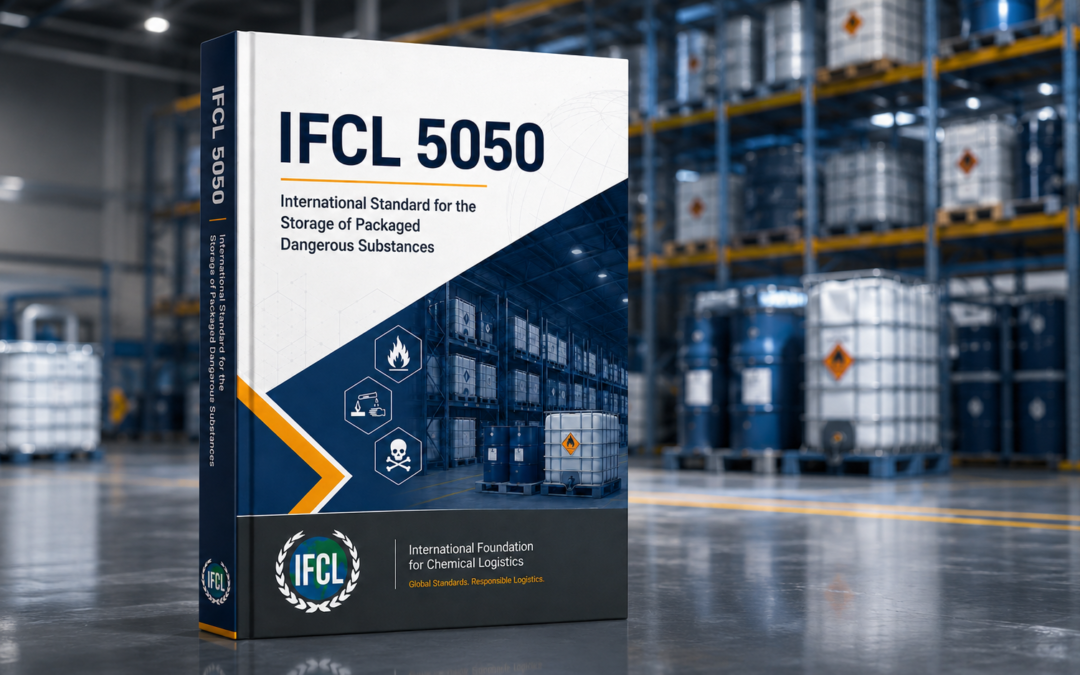
The International Foundation for Chemical Logistics (IFCL) has published the draft version of IFCL 5050 – International Standard for the Storage of Packaged Dangerous Substances. The new standard has been developed to support companies, logistics service providers, warehouse operators and safety professionals in managing the risks associated with the storage of packaged dangerous substances.
Chemical warehousing plays a critical role in international supply chains. Packaged dangerous substances are stored in a wide range of environments, from dedicated chemical warehouses and logistics hubs to production sites and distribution centres. Although many countries have national rules and guidance documents, the practical safety challenges are often similar across borders. Fire, chemical reactions, spills, incompatible storage, environmental releases and emergency response failures remain important risk scenarios for the sector.
About the IFCL5050
With IFCL 5050, IFCL aims to provide a clear and internationally applicable framework for safer chemical warehousing. The draft standard combines technical, operational and organisational requirements in one structured document. It focuses not only on physical safety measures, but also on management systems, competence, inspection, emergency preparedness and continuous improvement.
The standard covers the full safety lifecycle of chemical storage. It starts with major accident scenarios in chemical warehousing and the correct use of chemical information and hazard identification. It then addresses segregation principles, storage philosophy, warehouse design, physical safety barriers, fire prevention, fire protection systems, spill control and environmental protection.
Operational safety is also an important part of IFCL 5050. The draft standard includes requirements and guidance on warehouse operations, material handling, inspection, maintenance, asset integrity, training, competence and safety culture. In addition, the standard introduces performance measurement, auditing and continuous improvement as essential elements of a mature chemical warehouse safety system.
A distinctive feature of IFCL 5050 is the inclusion of practical assessment tools. The appendices contain a chemical compatibility and segregation matrix, a chemical warehouse safety inspection checklist, a fire protection benchmark assessment tool, an emergency preparedness and response benchmark tool, a safety maturity assessment model and an IFCL recognition scoring matrix with assessor guidance.
IFCL Recognition Framework
The draft also introduces the IFCL Recognition Framework, supported by an assessment protocol and scoring methodology. This framework is designed to help organisations evaluate their current level of safety maturity and work towards independent recognition of good practice in the storage of packaged dangerous substances. According to IFCL, the standard is intended to support international harmonisation and professionalisation within chemical logistics. It can be used by warehouse operators, chemical producers, logistics companies, auditors, consultants, insurers, authorities and training organisations as a reference document for improving safety performance.
The publication of the draft version marks an important step in the development of a broader international framework for chemical logistics safety. IFCL invites stakeholders in the chemical warehousing and dangerous goods sector to review the draft, provide feedback and contribute to the further development of the standard. By bringing together practical experience, technical safety principles and a structured assessment approach, IFCL 5050 aims to become a valuable reference for organisations seeking to improve the safe storage of packaged dangerous substances worldwide.
ORDER IFCL5050 Ebook
About the IFCL
The International Foundation for Chemical Logistics has published the draft of IFCL 5050, a new international standard for the storage of packaged dangerous substances. The standard provides a practical framework for safer chemical warehousing, including segregation, fire protection, spill control, emergency preparedness, training, inspection and safety maturity assessment. Stakeholders are invited to review the draft and contribute to the further development of this important international reference document.